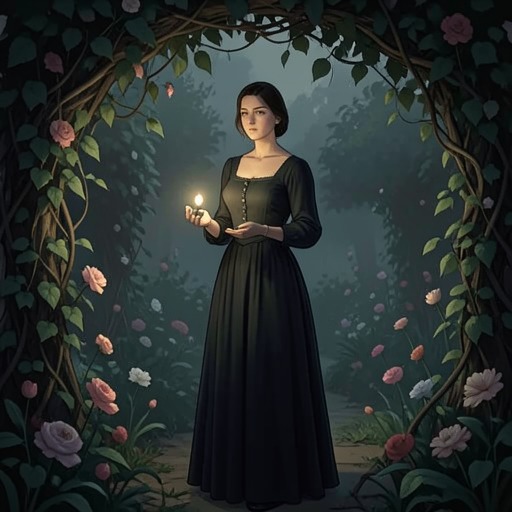
Balga
Csongor és TündeBalga is a farmer who becomes Csongor’s servant, but his place in the story is more than that of a subordinate companion. He travels alongside the questing prince, supplies a worldly counterpoint to Csongor’s pursuit of Tünde, and helps carry the play from the uncertainty of the crossroads to its final scene, where his arrival with Ilma interrupts the lovers’ private moment with a burst of marital comedy.
Identity and Introduction
The play’s character list identifies Balga first by his occupation: a cultivator of the land, later Csongor’s servant. This change in status gives his journey a double character. He is not introduced as a noble or as a supernatural guide, but as a working man who enters the orbit of a prince and becomes his traveling companion. The contrast between their stations shapes the partnership without erasing Balga’s independent presence.
His first appearance in the supplied scenes is marked by a simple stage direction: Balga enters, then exclaims in distress. The brief entrance gives him an immediate physical and theatrical presence, rather than presenting him only as a name attached to Csongor. Later, when Csongor asks what he is called, Balga begins his reply with a teasing or evasive turn. The exchange establishes a comic register in which identity itself can become material for banter.
Life and Plot Trajectory
Balga’s story unfolds across the road scenes that organize the play. At the three-way crossroads, Csongor confronts a landscape of diverging paths and uncertainty; Balga’s role as companion belongs to this unsettled world of travel. The crossroads is not merely a point on a route, but the setting in which the journey’s alternatives become visible. Balga enters that journey as a practical, earthbound presence beside a hero whose purpose is bound up with finding Tünde.
Their relationship is explicitly tied to Csongor’s movement toward Tündérhon. Csongor asks Balga to be his guide on the way there, a request that gives the servant a function in the quest beyond simply following his master. The social hierarchy remains legible—Balga serves Csongor—but the request also depends on Balga’s companionship and participation. The journey therefore makes their bond active: Csongor’s pursuit requires a fellow traveler, and Balga is positioned to accompany him through the changing scenes.
Balga appears at another crossroads scene in the second act, where the stage direction places the action in the region of the three-way road. This recurrence links the setting to the play’s larger movement rather than confining it to a single decision point. The road repeatedly gathers characters and choices, and Balga’s presence in its orbit emphasizes that Csongor’s elevated romantic search proceeds alongside the servant’s more grounded, comic experience of travel.
Key Actions and Objectives
Balga’s words show that he pays attention to Csongor even when the prince is absorbed in thought. He addresses him as “Csongor úrfi” and asks what is occupying his mind. The form of address keeps their difference in rank audible, while the question makes clear that Balga is not a silent appendage: he notices his master’s inward preoccupation and attempts to draw him into conversation. His attention gives the pair a human, conversational connection amid the larger quest.
That attentive companionship is distinct from the role of a formal guide. Csongor’s request that Balga lead him toward Tündérhon points to practical dependence, while Balga’s later question about his master’s thoughts points to personal familiarity. The two functions coexist: he helps accompany the outward journey and remains close enough to register its emotional burden. The evidence does not make him the author of Csongor’s goal, but it does make him part of the lived passage toward it.
At the end, Balga enters while dragging Ilma along. His action abruptly shifts the stage picture from the intimate approach of Tünde to the familiar, comic friction of a couple. The physical business of hauling Ilma is unmistakable, and Balga’s ensuing complaint against his wife confirms that their arrival is not a ceremonious reunion. Instead, they bring their own quarrel into the scene, making the servant couple’s domestic troubles a counterpoint to the lovers’ long-delayed happiness.
Relationships and Conflict
Balga’s central bond is with Csongor, whose servant he becomes after beginning as a farmer. Their master-servant relation contains both deference and companionship: Balga addresses Csongor respectfully, yet speaks to him directly about his thoughts and accompanies him through the journey. Csongor, in turn, entrusts Balga with a guiding role on the way to Tündérhon. The relationship is thus hierarchical in name and circumstance, but dramatically sustained by shared travel and conversation.
His relationship with Ilma provides a second, contrasting partnership. At the close, Balga’s entrance with Ilma is accompanied by a reproachful address to his wife, presenting their marriage through immediate comic conflict rather than idealized harmony. The scene places their quarrel beside the approaching union of Csongor and Tünde. Balga and Ilma’s domestic discord does not cancel their bond; it gives the play a deliberately ordinary, imperfect version of couplehood alongside its enchanted romance.
The contrast also clarifies Balga’s place in the social and emotional design of the play. He moves between service to a prince and life as a husband, and the final scene lets both identities meet onstage. His attention to Csongor’s troubled mind belongs to the traveling partnership; his complaint and physical entanglement with Ilma belong to married life. Together they prevent the ending from belonging exclusively to the elevated lovers.
Change, Ending, and Narrative Role
Balga’s defining change is social and relational: the farmer becomes Csongor’s servant and fellow traveler. The evidence does not describe a transformation into a different kind of being or a separate final reward for him. Instead, his development is measured through changing functions—working man, subordinate companion, requested guide, attentive observer, and husband whose quarrels remain visible at the end.
His entrances help mark the dramatic frame of Csongor’s search. Balga appears in the play’s road-bound world, returns around the recurrent crossroads, and is present again in the final movement. At the last, Csongor has just gone forward, and Balga arrives dragging Ilma as Tünde comes nearer alone. The crosscutting of these entrances makes the ending’s reunion less solitary than it might otherwise be: the lovers’ encounter is placed within a wider human company, where affection coexists with complaint and comic disorder.
Balga’s significance rests in that grounded counterpoint. Csongor’s journey is organized around the pursuit of Tünde and the distance between desire and fulfillment; Balga’s scenes keep attention on practical companionship, rank, and marriage as lived experience. He does not replace the romantic quest or solve it. He accompanies it, gives it a conversational and comic register, and returns at the close with Ilma to make the final tableau hold both enchanted love and ordinary couplehood at once.